


Wuthering Heights Movie Review

BY: ISABELA RANGEL / MANAGING EDITOR
I’ll set the scene for you: Northern England countryside. Your billowing skirts whip around you as you dramatically wait for your lover on the side of a cliff overlooking the sea. The mist slowly parts. The music swells.
And then you hear Charli XCX’s horror-techo single, “House” reverberate around you.
Welcome to Emerald Fennel’s “Wuthering Heights,” an audacious interpretation of the 1847 Emily Brontë novel of the same name. And while I personally believe the similarities end there, the film was meant to be less of a faithful adaptation and more of a fever dream donned in an anachronistic corset.
If you walk into this film hoping for a more direct retelling, you may find yourself clutching your pearls by the time the title sequence hits. But if you are willing to treat it as its own entity, a stylized, abstract piece of gothic fiction that sometimes mimics that of a peculiar fan-edit, there is some strange fun to be had.
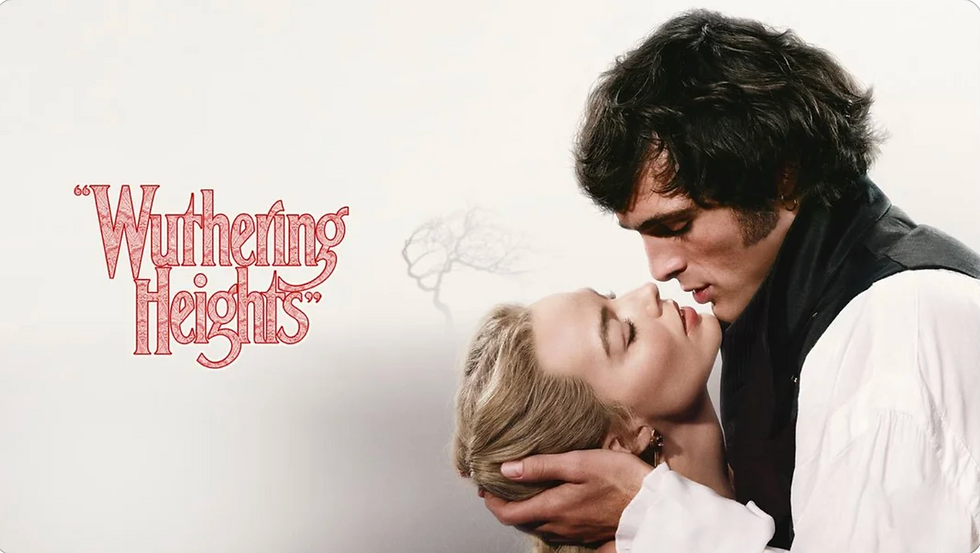
This two-hour and 16-minute film revolves around classic characters Catherine Earnshaw and Heathcliff, played respectively by Margot Robbie and Jacob Elordi. Robbie’s Cathy is a force to be reckoned with. She’s lively, stubborn, and luminously dramatic, a little unhinged for a woman of that time period, but in the best way possible. Robbie brings a warm energy to this role, one that keeps the movie from succumbing to its own melodrama (for the most part).
Jacob Elordi, meanwhile, portrays the Heathcliff we’ve all been picturing in our heads: scruffy, brooding, and mysterious, with a perpetual stare into the distance as if the sky has personally offended him.
The film received its first bouts of criticism for initially even casting Elordi as Heathcliff. In Brontë’s novel, Heathcliff is repeatedly described to suggest that he is not white, a detail that majorly contributes to how he is looked down upon by other characters.
It was a critique quickly pushed aside by Elordi’s committed performance, but the decision can’t help but feel like a missed opportunity. After all, the most anticipated movies of this year already couldn’t resist recasting the same top five names in Hollywood right now. I understand he’s your muse, Fennel. But muses can take the occasional day off.
Nevertheless, Robbie and Elordi shared an undeniable chemistry. So undeniable, in fact, that the movie is determined to remind you of it every ten minutes. In the original novel, Catherine and Heathcliff share exactly one kiss. Contrastingly, the film shows very little restraint and does very little to abide by the Victorian Era’s social rules.
Their younger counterparts, played earlier in the film by Owen Cooper and Charlotte Mellington, solidify the earlier chapters in the story. Cooper, fresh off recent wins at the Emmys and Golden Globe Awards, does well in portraying Heathcliff with a young and wounded intensity, one that does well in setting up his adult counterpart with a good tortured backstory.
Prior to the film’s release, Fennel described her approach to W Magazine as interpreting the story through the eyes of “a young girl who doesn’t really know what the Victorian or Georgian eras look like.” A concept that became increasingly obvious as the film progressed. Don’t think historical period piece. Think more historical vibes.
The aesthetic seems to appeal to a more glossy Bridgerton-esque version of the 1800’s. The hairstyles are intricate, the makeup is inherently modern, and the corsets are brighter (and are from H&M). Emotions are expressed through costumes and sets that seemingly pulled every shade from Pantone’s color department.

To the film’s credit, the visual storytelling was by far my favorite aspect of the movie, with cinematographers accounting for a shade to go with every emotion.
The Linton Mansion burst with color in every room and stairwell, the perfect setting for a distraught Catherine to dramatically drape herself over the staircase. The walls seemed to act alongside our players, heightening emotions and diffusing them when appropriate.
Only Catherine’s bedroom at the Linton Mansion, a place that should be regarded as her status’ saving grace, was a monotonous beige and pink, drained of color until her final moments when the color red seeps into the frame. It’s a striking burst of symbolism, but not the only one that stood out in the film. The scenes at Wuthering Heights, in contrast to the kaleidoscopic mansion, were damp and dreary, as if showing the underbelly of the countryside.
The soundtrack, however, is where the movie begins to slip out of my good graces.
Experimenting with music in a period piece is not a new idea, and it’s not even a terrible one. Plenty of movies have pulled it off uniquely and commendably (see my previous homage to Bridgerton). But the reiterated use of Charli XCX’s techno album, the distorted and remixed tracks to accompany montage after montage, began to feel less like an abstract choice and more like someone accidentally opened TikTok with their phone on max volume.
Did I like this movie? Yes, very much so.
Do I think it should be called Wuthering Heights? Not even in the slightest.
Strip away the title, and Fennel’s 2026 adaptation is simply entertaining, colorfully stylish, and passionate. If it were marketed more as an original romance with inspiration loosely drawn from 1800’s gothic fiction, it might’ve even been viewed in a more refreshing light from critics. But as a retelling of Wuthering Heights, it struggles to meet the novel’s harsh expectations that Fennel never really intended to meet.
Rating: 6/10


This is one of the few profiles where the shared information feels simple and easy to follow. I was checking out Kohi Click Test for CPS score practice and different mouse clicking techniques online.